Put on your headlamp: Bringing Design Thinking to Data Governance
As Rabobank's Data Platform grew, so did the complexity of data governance. To understand how data producers and owners experienced governance in their daily work, we partnered with Chapter Design and applied Design Thinking. The result was a shift from focusing on processes and controls to focusing on people.

- Hanna Mironchyk Global Data Platform, Data Management Lead
- Esther WieringaSenior UX Designer
A growing platform with a human challenge
At Rabobank's Data Platform, data governance helps hundreds of teams to use and manage data. It has grown into a global ecosystem connecting data producers, consumers, and governance capabilities across the organization.
As the platform expanded, new capabilities were introduced, like data quality monitoring, lineage, issue management and data ownership. These are essential for trustworthy and reusable data. Yet, the technical implementation is only part of the story.
This article shares what we learned from working with Design and why putting people at the centre can improve even the most technical domains.
Shining a light on the human experience
When we gathered initial feedback through surveys, focus groups and ad-hoc conversations, a clear theme emerged around how people experienced governance in their daily work. We saw opportunities to make the experience more intuitive, documentation easier to navigate and create a clearer connection between individual requirements and the bigger picture.
Rather than immediately creating new solutions, we realized we needed a better understanding of the people experiencing these challenges.
We therefore asked Rabobank’s Design team to help us look at the challenges from a different perspective. Together, we used Design Thinking to understand how established governance processes and controls could become more intuitive and actionable for the people working with them.
Starting with people, not the product
One of the core principles of Design Thinking is to start with people, not solutions. So, Design facilitated a series of in-depth interviews with people across the organization. The focus was on understanding their goals, frustrations, motivations, and ways of working. We needed to understand the reality of working with data in a complex organization.
The interviews provided insights that would have been difficult to obtain through metrics or process documentation alone.
We knew data governance could be hard to navigate, but interviews revealed why. It changed our interpretation of the problem. Data governance is rarely anybody's primary job. Business Owners, Data Set Owners and provider teams are focused on delivering business value. Governance activities support that work, but they compete with many other demands for people’s time and headspace. Understanding that context helped us see the challenge differently.
We began to see where frictions exist, why they exist and where opportunities lie to make data governance clearer and easier.
Looking beyond the first idea
A common temptation is to jump straight into implementation. But your first idea is rarely the best solution.
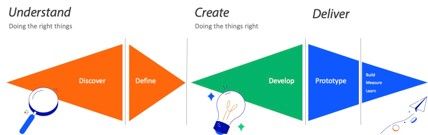
The Design team encouraged us to do the opposite: explore broadly before deciding what to build. They facilitated ideation workshops, which allowed us to explore many different directions and pushed us to think beyond the obvious. Solutions ranged from better onboarding to self-service capabilities, proactive reporting, and better communication mechanisms.
More importantly, it changed how we thought about solutions, not every idea requires new technology.
Testing assumptions early
Building a new solution can require significant investment. To mitigate the risk of building the wrong thing, it’s important to test assumptions early. At this moment, our solutions were still based on what we believe is the best solution to the problem. The question remains whether those beliefs are correct.
One of the high-potential ideas was ‘proactive data reporting’. We explored how we can proactively report on the status and quality of a Data Product.
Before building a fully automated solution, we created a light-weight prototype and gathered feedback from data producers. The goal was to test our key assumptions. Would this report be understandable and effective?
The feedback proved incredibly valuable. Participants appreciated having a clear overview of actions. At the same time, they highlighted that simply showing issues was not enough. They wanted to understand why something mattered and exactly what they should do next.
This caused a shift in the approach. The goal was no longer just to provide information, but to make information actionable.
What we learned
One of the most important insights from this journey is that data governance is fundamentally a human challenge. We can establish standards, implement controls and build sophisticated platform capabilities. At the same time, how people experience governance influences how easily they can understand requirements and take the right next steps.
Design thinking helped us add another perspective alongside questions such as:
"Have we implemented the process?"
and complement them with questions like:
"Do people understand what this means for them?"
"Can they easily take the next step?"
"Are we helping them succeed?"
Those questions are as important as any technical decision.
Why this matters for engineers
Although Design Thinking is often first associated with customer-facing products, the underlying principles apply equally well to internal platforms, engineering teams, and data domains.
The challenges we face are not always technical.
Whether you're building a data platform, an API, a developer tool or a governance process, there is a simple lesson worth remembering: explore first and build second.
Because sometimes the clearest path forward is discovered not by looking at the technology, but by shining a light on the people who use it.