How Women Shaped the Tech Industry
It might come as a surprise to learn that computer programming was once predominantly a woman’s job. Today, while the tech industry is predominantly a male-dominated field, it’s hard to imagine that the entire field of tech is built up by women.In this blog, I’ll share how women shaped the tech industry and what we can do to close the gender gap in tech.

- Britt StaalCommunity Manager
Origins of computer programming
Major technology breakthroughs all began with Ada Lovelace, often celebrated as the first computer programmer, who wrote the initial algorithm intended for execution by a computer (the Analytical Engine). But she wasn’t alone; many of the first programmers and pioneers of programming were women, like Grace Hopper, Margaret Fox and Katherine Johnson. Women were programmers even before the work was called programming, and they played a crucial role in shaping the tech industry.
In the 40’s and 50’s, the field of computer programming began to professionalise. Automation and digitalization increased, and the demand for technical staff started growing with many women holding roles of programmers, systems analysts, data processors, and key-punch operators. Although companies were keen on recruiting women, this was mostly because women were typically considered cheaper and more obedient than men. Not because they were seen as talented and suited for management jobs.
In the 60’s, many people saw computer programming as a natural career choice for young women. Through their article “The Computer Girls”, Cosmopolitan Magazine advertised the field of tech as offering better job opportunities for women than many other professional careers. Computer scientist Dr. Grace Hopper even told a reporter that programming was just like planning a dinner: “You have to plan ahead and schedule everything so that it’s ready when you need it…. Women are ‘naturals’ at computer programming.”
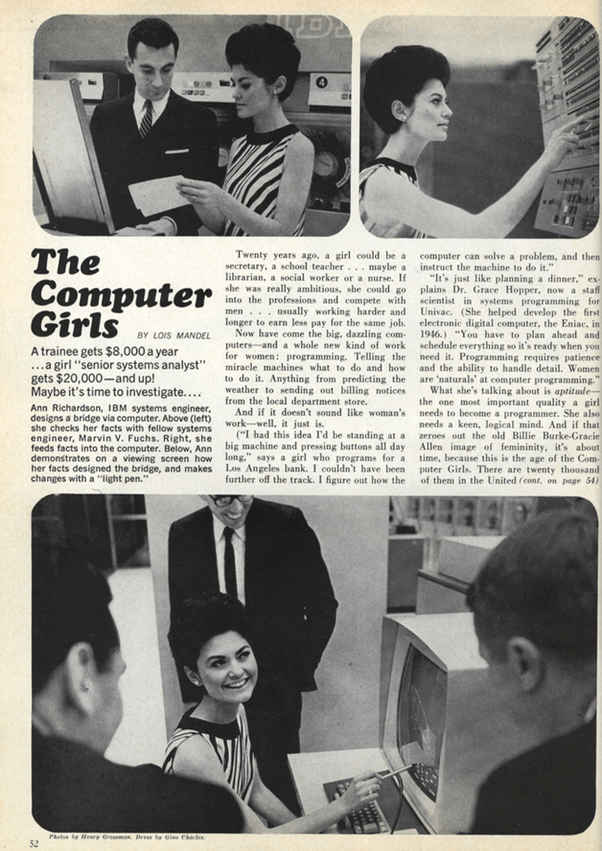
Shift in perception
The 70’s and 80’s marked a changing view on computer programming and a significant decline in the number of women in tech. During this period, computers were increasingly being marketed as ‘boy’s toys’. Commercials from companies like Apple and Radio Shack highlighted the appeal of personal computers for boys, while girls were often depicted as outsiders to the computing world.
Earlier on computer programming was seen as an easy job, like typing or filing. Software development was less important than the development of hardware. So, women worked on software, men on hardware. But as the software field gained prestige, it began to be seen as challenging and exclusive to those with advanced technical skills.
Male programmers wanted to elevate their job out of the ‘women’s work’ category, so they started excluding women by creating professional associations and discouraging to hire women. They introduced math puzzle tests in the recruitment process, which gave men an advantage, as they were the ones that often took math classes. They introduced personality tests to find ‘the ideal programming type’ and favoured candidates with a ‘disinterest in people’— contributing to the antisocial nerd stereotype we see today.
Managers excluded women from upper management jobs and preferred to keep women in ‘inferior’ jobs. Assuming women had plans to marry and get children, they were often overlooked for a promotion. Instead, managers more readily promoted white, college educated men instead, even though some women had more relevant work experience.
Resurgence of women in tech
As a result, women were forced out of the industry, and history was rewritten to view tech as a male industry. During the 90s and early 2000s, the industry continued to grow with the rise of the internet and the dot-com boom. However, it became increasingly difficult for women to enter this male-dominated industry, with a pervasive 'boys culture'.
Since then, women have been trying to re-enter the tech industry by proactively addressing barriers, sharing their experiences and advocating for change. Many organizations and initiatives have been encouraging (young) women to pursue careers in technology, by providing mentorship, training, and support. Prominent women like Sheryl Sandberg (COO of Meta), have entered the field, inspiring many other women.
Future outlook
Despite the strides made, women remain underrepresented in the field of tech. Globally, only 25% of all tech employees are women. The gender gap is even bigger at the top, with women making up just 11% of executive roles in tech. Next to that, the field of tech also has a big gender pay gap. European women in tech make, on average, 26% less than men. These numbers make it clear that we’re still suffering from the ‘anti-social nerdy guy in a hoodie’-stereotype. This stereotype is further reinforced by societal norms that often encourage girls to be polite, obedient and focus more on the social aspect, while boys are taught to be bold, assertive and focus more on the technical aspect.
Closing the gender cap
Understanding this history is crucial for addressing the gender gap in tech. By recognizing the foundational role women played in shaping the tech industry, we can work towards a more inclusive and diverse field. There are many ways to support women in tech and roughly, we can focus on three key areas: attracting, retaining, and growing female talent in tech.
1.Attract
To attract more women in tech, we need to actively hire for diversity. This includes rewriting job descriptions to appeal to women, ensuring a balanced gender ratio in interview invitations, and having diverse interview panels. Most importantly, avoid discouraging women with questions like, "Are you sure you want to work in this male-dominated field?" Such questions imply that women need to adapt to a toxic culture, which undermines the benefits of diversity.
2. Retain
Once women are hired, it's essential to create an environment where they feel valued and respected. It’s important to build a culture of psychological safety and trust, where women's perspectives on technology, processes, and tools are appreciated. Offer employment terms that matter to women, such as flexible working hours, a good work-life balance, and equal pay. Additionally, provide support for women during and after pregnancy leave.
3. Grow
Creating an environment where women can flourish and grow is vital. Offer development, mentorship, and/or sponsorship programs. Provide spaces where challenges and barriers can be discussed and overcome. But maybe most importantly, encourage advocacy for women (in tech) at all organizational levels.
Conclusion
The journey towards a more inclusive and diverse tech industry is a collective effort and starts with recognizing the vital role women played in shaping the tech industry. With this article I hope to inspire you to contribute to creating an environment where everyone can thrive. Every action, no matter how small, contributes to building workplaces that celebrate women in tech.