The Power of a Tribe: “I Wish Everyone Could Experience the Feeling of Belonging

- Reading time
Why André Believes Inclusion Is Just as Essential in Sports as It Is in the Workplace.
From a queer volleyball club in Amsterdam to the Rainbow network at Rabobank, Brazilian colleague André Moreira Dias has learned how powerful it is to be part of a community where you can truly be yourself. Now that the annual WorldPride has kicked off in Amsterdam, he shares his personal story about belonging, visibility and why inclusion matters just as much on the sports field as it does in the workplace.
Service designer André Moreira Dias grew up in southern Brazil, thousands of kilometres away from Amsterdam. Yet when he reflects on the communities that have shaped him over the years – at work, in sport and in life – a common thread emerges. “Find your peers,” he says. “Find your safe place.” It is advice born from experience.
André moved to the Netherlands ten years ago, originally intending to broaden his horizons by studying abroad. What began as an adventure turned into a new life. “I am originally Brazilian and moved here from the southernmost state of Brazil, close to Uruguay and Argentina. We barbecue a lot,” he says with a laugh. “There’s a strong Argentinian gaucho culture there. But it’s also a place with quite a macho culture, so that gives you a sense of the environment I grew up in.”
He chose Delft University of Technology over another attractive option in Finland. “Both universities were excellent,” he says. “But in the end I thought: Finland is way too cold.” The decision changed the course of his life.
Welcoming complexity
After completing his master's degree, André built a career in design and consulting before eventually joining Rabobank, where he now works as a service designer within Wholesale & Rural. His role is less about creating screens or campaigns and more about helping the bank understand and improve the journeys of clients and employees.
“We identify different customer and employee journeys and help measure them so we know we're investing in the right improvements,” he explains. “What I really like about Rabobank is that it’s a complex organisation. That complexity makes design valuable, because there are so many experiences to improve.”
Growing up between progress and prejudice
André describes his home country as a country of contradictions. “Brazil is a nation of paradoxes,” he says. “On one hand, LGBTI+ rights are relatively advanced. Same-sex couples can marry and adopt children. Conversion therapy is banned. Trans people can legally change their names and identities. Yet Brazil is also known for high levels of violence against LGBTI+ people, particularly trans individuals. It’s very polarized. You have incredibly progressive cities, politicians, artists and activists, like the first openly transgender councilor Erika Hilton and the singer-songwriter Liniker. But at the same time there are also very conservative forces. There’s a constant tension between those two realities.”
Active communication and ongoing attention
Before joining Rabobank, André worked for an international consultancy where he felt something was missing. “There was a lack of representation,” he recalls. “I remember asking: why are we not celebrating Pride? Why are we not creating awareness?” For André, visibility is not a symbolic extra. It is something that directly affects whether people feel welcome and safe. “It’s important for me to feel welcomed and safe in an environment.” That is one of the reasons he connected with Rainbow, Rabobank’s employee network for LGBTI+ colleagues and allies. Although his schedule does not allow him to participate in every activity, he values the role the network plays within the organisation.
“At Chapter Design we were kind of the fun bunch,” he says. “We almost never wore suits. In other parts of the organisation, particularly in more traditional banking environments, standing out can feel more challenging. When you are very different, you stand out more. That can feel uncomfortable. There’s a bigger pressure to conform.”
But that does not mean he feels unwelcome. Far from it. Instead, he believes organisations must consciously create space for people to bring their full selves to work. “To make everyone feel seen in their uniqueness, you need to actively communicate that it’s okay to be yourself. Rabo does that quite well”
Finding his tribe on the volleyball court
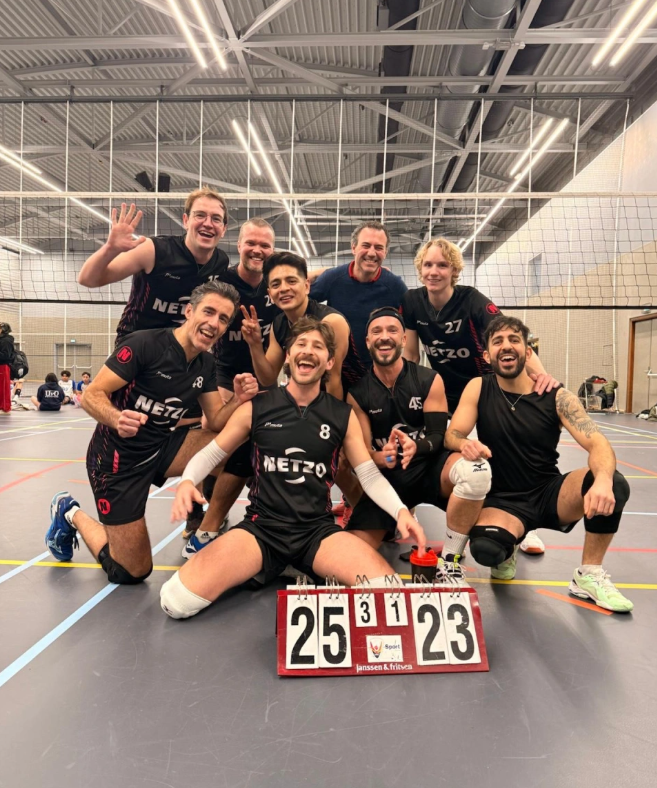
If Rainbow helped André find community at work, volleyball helped him find it outside work. Five years ago, he joined Netzo, Amsterdam’s queer volleyball club. Today, the club has grown into a thriving community of roughly 250 members. “It’s much more than a sports club,” André says. “It’s a community.”
That experience shaped the way he views sport today. For many people, joining a sports club is straightforward: they simply show up and play. But for LGBTI+ people who have experienced exclusion, judgement or intimidation, sport can feel very different. What Netzo offered André was not just volleyball. “It gave me a sense of community,” he says. “At this club, all the members can bring their full selves to the court.”
A safe place to be yourself
The thirty-year-old club Netzo is one of several queer sports clubs in the Netherlands and participates in both regular competitions and LGBTI+ sporting events. On the volleyball court, Netzo competes against university teams, neighbourhood clubs and other local teams.
“Although we play in the 'regular' league, we empower ourselves within our teams to excel in the same environment,” André says. “At the same time, the club provides something that goes beyond athletic achievement. There’s a cultural aspect as well. We share experiences, festivals, Pride celebrations. There’s a queer culture embedded in the club that makes it unique.”
For André, true progress will be visible when athletes no longer need to choose between authenticity and success. “When people are hired, selected and celebrated for their talent regardless of their identity, that’s progress.”
What sport and work have in common
Interestingly, André sees strong parallels between inclusion in sport and inclusion in the workplace. The biggest difference, he says, is visibility. “In sport, you have to communicate constantly. If you don’t speak up, you don’t get the ball. In the workplace, things are often much more subtle. It can be harder to explain your needs or make yourself heard. That challenge is familiar to many people, whether they belong to the LGBTI+ community, are women in leadership, or come from an international background.”
As a Brazilian professional navigating Dutch corporate culture, André experienced this himself. For a period, he worked primarily in Dutch and invested significant effort in mastering the language. “But at some point I realised I would never be able to express myself as professionally in Dutch as I can in English,” he says. “Communication shapes how people perceive expertise and credibility. That can be difficult because communication is the key to everything. The result is that many people learn to adapt. We all conform a little bit depending on the environment. Which is exactly why networks, communities and safe spaces matter.”
When asked what advice he would give colleagues who feel different or who struggle to find a place where they can fully be themselves, his answer comes immediately: “Find your network. Not necessarily within your own team. It may be Rainbow. It may be RaboWomen. It may be a colleague, mentor or community outside the bank. Rabobank is huge, there is definitely someone going through similar things.”
Do you want to know more about Rabobank?
Discover hereVacatures
Bekijk alle openstaande vacatures en solliciteer!
- Project Finance Summer Analyst Intern
- Hybrid
- New York (US)
- 40 hours
- Internship
- Junior Data Scientist | Advanced Analytics Early Career Program | Utrecht
- Hybrid
- Utrecht (NL)
- €3,516 - €5,021 (scale 07)
- 40 hours
- Full time
- Meewerkstage Operations Business Lending - Eindhoven
- Hybrid
- Eindhoven (NL)
- €600
- 36 hours
- Internship
- Stagiair Recruitment Young Talent of IT Recruitment
- Hybrid
- Utrecht (NL)
- €600
- 36 hours
- Internship
- Stagiair Klantvalidatie | Online Hypotheektools | Utrecht
- Hybrid
- Utrecht (NL)
- €600
- 36 hours
- Internship