Will I be fired by AI?
With the introduction of Chat GPT new opportunities have arisen, together with fears and doubts about the future. My colleague, Bruno Sant’Anna, has written about the impact Chat GPT can have on the banking world. In his blog ) different fields were mentioned where AI could impact the banking world. This can lead to some to consider how safe their job is.
In this blog I would like to discuss the challenges that a world with AI might bring. I will be doing this placing AI in an historical context and using the opinions of some critical thinkers. Although Chat GPT might be new, our reaction to it certainly is not.

- Wouter MertensBusiness Analyst for Tribe Data & Analytics
A technological revolution in Rouen in 1645
To answer what the future might bring I will start with the past. In the summer of 1645, the city of Rouen was full of excitement. The reason for this was that the famous mathematician, philosopher and all-round genius, Blaise Pascal, invented a ‘thinking machine’. If this were true, a future of machines replacing human beings could be possible.
The reality was that Pascal invented a mechanical calculator for his father who was a tax collector. Why the contemporaries of Pascal considered this a ‘thinking machine’ was that they believed calculations could only be performed by human beings, because it required intelligence. If machines could calculate they would be intelligent and if that were so, what else could be possible?
This example clearly illustrates two things. The first is that people in all times can get easily excited with new innovations, leading to expectations that are not met in the short run. We currently believe that computers might become intelligent, and a calculator can be seen as the basis of what a computer is. As such the idea that the citizens of Rouen had was not farfetched. However, it will take more time and effort to reach the result.
The second aspect is that the definition of intelligence can change. In the 17th century calculations were seen as intelligent actions. Today we know that calculating is following a set of rules or an algorithm. This is not seen as intelligence but as a predictable process. Therefore, a machine doing calculations is not seen as a sign of artificial intelligence and as such we have changed our perception of what intelligence is.
Will machines take over?
Using the historical example of the Pascal calculator and accepting that these machines were also considered ‘thinking machines’ we can be assured that chances are high that people will not be replaced by artificial intelligence. Just like the calculator, artificial intelligence can be a beneficial tool, which can perform certain tasks. These tasks are currently ascribed to signs of intelligence according to the Turing test, but they are still procedures. Although the outcome is less predictable than the calculator, it is still a procedure. In essence, AI is limited and cannot replace us.
Man, and machine against AI
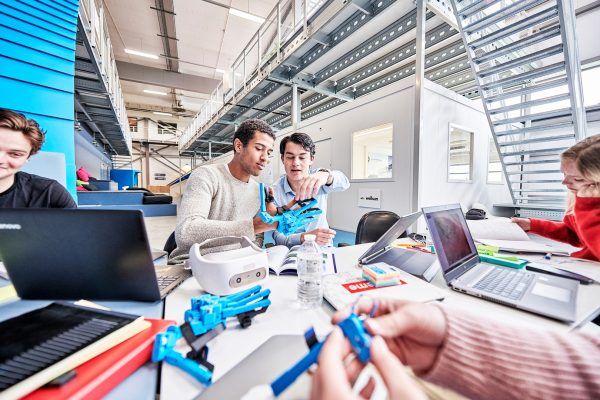
The way AI will impact our life is in the combination between man and machine. Humans will use artificial intelligence to help them create products and services. This is because just like a calculator can perform difficult computations so that a scientist can better understand the experiment, so too will we be using new AI to further society. It is the man machine combination that is extremely powerful.
This can be exemplified by what is happening in the chess world. When DeepBlue defeated Kasparov in 1997, this really signified that human chess players could do well but could never defeat a sophisticated piece of software like DeepBlue. However, a mediocre player coupled with a simple computer program can easily defeat DeepBlue. This is because although DeepBlue is immensely powerful in its computations, it cannot think about new moves and new opportunities. Give a human a tool that can do simple computations and the combination is more powerful than the tool alone.
Challenges ahead
If we want to use artificial intelligence as a tool, there are definite challenges to overcome. An important one is that human beings need to have the time and resources to learn/ adapt to these new applications. They need to be included.
This inclusion takes effort and time. Just adapting to an innovative technology is not as easy as we might rationally think. Adapting to new techniques will take effort because how we use technology is subconsciously imprinted in our body and not only in our thinking.
To clarify this one can, use the QWERTY keyboard as an example. This keyboard was invented because old typewriters worked with hammers that pressed against ink paper. The QWERTY keyboard was designed to prevent the hammers from crossing each other and getting stuck. The QWERTY keyboard was one of the designs that improved on this and became the standard.
Now currently all computers no longer use hammers to press ink on paper, but just imagine if tomorrow all QWERTY keyboards were replaced. Would we like it? No, even if the replacement keyboard were more efficient it would take time to get to know how to use the keyboard. This is not because we do not want to choose for the new keyboard on a conscious level, but because we trained our fingers to type as fast as possible without thinking.
Towards an inclusive society
Once we accept that learning modern technology and adapting to it takes time, the responsibility we have is to ensure we include everyone in society that they can use modern technology. This is especially important for banks who have a pivotal role in society. The DNB (Dutch National Bank) has argued that banks need to take this role more seriously after a report that stated that a lot of people have difficulty using the new technological products banks are offering.
In conclusion, I do think that the future can be bright. I also think that AI can be positive and help us with our daily work. It will not replace people, but we must take measures that it does not exclude people. Companies and government need to provide the resources and time for people to successfully adapt. Therefore, I am happy to work for Rabobank who has ‘working towards an inclusive society’ as one of its three core values. Working in the tech department of Rabobank, we are not only inventing innovative technology, but also working on how to make this innovative technology work for everyone. If every company does this, I think the future will be bright.
About the author
- Wouter MertensBusiness Analyst for Tribe Data & Analytics