Tech Radar: Driving Java Standardization at Rabobank
At Rabobank Digital Platform, we’re always looking for ways to bring our teams closer and create a unified approach to technology. As part of the Java Chapter, it’s crucial that we maintain consistency across our tech stack while also giving engineers the room to innovate and grow. This is where the Tech Radar comes into play, helping us visualize the technologies we use and guiding our decision-making.

- Ali MeshkatJava Chapter Lead / Java DevOps Engineer
This article explores how the tech radar promotes standardization, promotes knowledge sharing, and empowers engineers to innovate. By gathering insights directly from our team, we ensure our tech choices reflect real-world needs in our ongoing commitment to excellence in technology.
Defining the Tech Radar and its key benefits
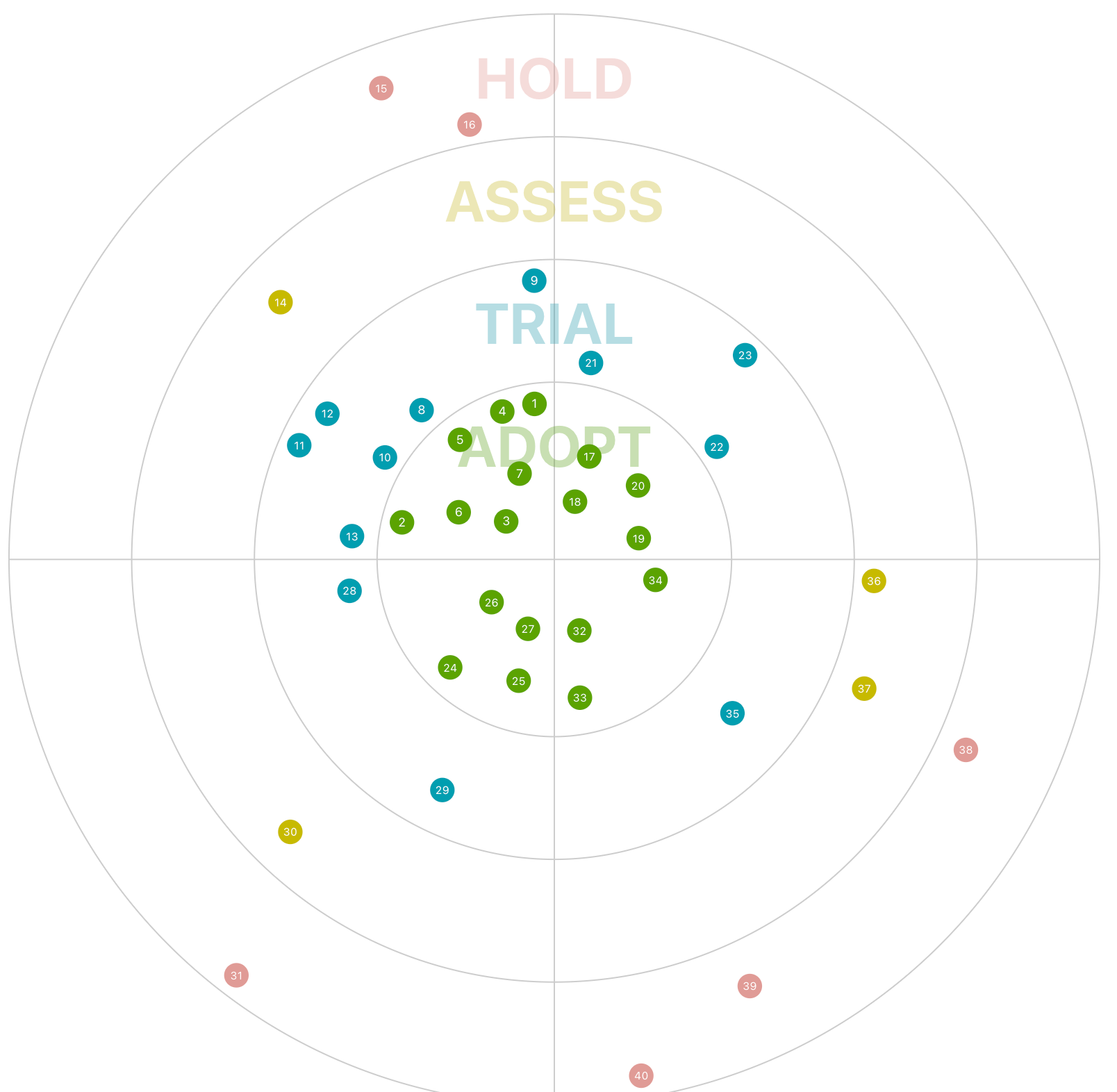
A Tech Radar is a tool that helps organizations visualize their technology landscape. It categorizes technologies into different stages such as Adopt, Trial, Assess, and Hold, providing clear guidance on their usage and status.
Adopt: Technologies that are widely used, supported, and well-maintained by the community or a vendor. These are recommended for most common use cases.
Trial: Technologies that have proven useful for certain use cases but require more adoption and knowledge sharing before moving to the Adopt ring.
Assess: Technologies that are in the exploration phase, where more investigation is needed to determine their usefulness for regular use cases.
Hold: Technologies that are no longer recommended for new projects due to better alternatives or other reasons.
This categorization helps teams make informed decisions about which technologies to use, experiment with, or phase out.
Community-driven insights
The Tech Radar data is not created in isolation—it’s distilled from a Tech Inventory survey that we conduct across all engineers within the Digital Platform (DP). This survey, which will be a recurring initiative, gathers insights directly from our engineers to understand which technologies are currently in use, which tools are showing promise, and which ones we should reconsider.
By involving all Java engineers in this process, we ensure that the Tech Radar reflects the real needs and experiences of the people working with these tools every day. This survey-driven approach also means that the radar stays dynamic and evolves with the changing landscape of technology and the growing expertise within our teams.
Driving Standardization across teams
One of the biggest challenges in a large organization is ensuring that all teams are aligned on the same technology stack. The Tech Radar helps us achieve standardization across the Java Chapter by clearly defining the core technologies we use and providing direction for new projects.
However, it’s important to emphasize that the radar represents a recommended stack for the average application—not a rigid set of rules. While tools like Java, Spring Boot, and PostgreSQL are placed in the Adopt ring and serve as foundational technologies, the Tech Radar allows for flexibility. Different applications often have unique requirements, and big deviations from the standard stack are possible when justified. There’s no one holding teams back if they need to explore other options that better fit their specific needs.
Additionally, by using the Tech Radar as a reference, squads starting new projects can easily see which technologies are recommended, under trial, or should be avoided. This helps reduce duplication of effort and prevents teams from adopting outdated or unsupported technologies, allowing everyone to focus on building scalable and secure solutions.
Building expertise through knowledge sharing
Tech Radar also supports our mission to continuously build expertise and share knowledge within the Java Chapter. Since the technologies in the Adopt ring—like Spring Boot or Kotlin—are widely used, we organize focused workshops, tech talks, and training sessions around these tools. This ensures that all our engineers are up to speed on the technologies that are crucial to our platform’s success.
Moreover, by identifying newer tools or frameworks in the Trial or Assess rings, engineers who are testing these technologies can share their learnings with the broader team. This collaborative approach helps us make more informed decisions about whether these technologies should move into wider adoption or be phased out.
We encourage teams with deep expertise in specific tools to provide support and best practices to other squads. This helps everyone across the Java Chapter to continuously improve their skills and contribute to a stronger, more capable engineering community.
Promoting Innovation and Experimentation
While Tech Radar provides guidance on standard technologies, it also encourages innovation and experimentation. The Trial and Assess rings are specifically designed to allow teams to explore and experiment with new tools and technologies that fall outside the standard stack. We want our engineers to experiment beyond the Adopt ring, testing promising technologies that might eventually become part of our core stack.
In fact, the Tech Radar helps us monitor where experimentation is happening and where things might have settled too much. If everything is in the Adopt ring and there’s not much activity in Trial or Assess, it could be a sign that we need to encourage more exploration and innovation. By keeping a healthy balance of technologies across all rings, we ensure that we’re always exploring new opportunities to speed up and innovate and not stagnating with a rigid set of tools.
Final thoughts: Empowering our Java Engineers with the Tech Radar
The Tech Radar, driven by insights from the Tech Inventory survey, plays a critical role in shaping the technology decisions at Rabobank’s Java Chapter. It not only helps us standardize our tech stack and align our teams but also fosters a culture of continuous learning, innovation, and collaboration. As we move forward, Tech Radar will remain an essential tool for ensuring we use the right technologies and grow our expertise, all while keeping our focus on building scalable, innovative, and secure solutions for Rabobank’s Digital Platform.