Sustainability at home and at the office
Most of us are already incorporating sustainable practices in our private lives, at least to save the cost of energy. It is important for our survival on this planet if we also implement a sustainable way of thinking and implementing at the office.
In this article, I want to talk about my journey of implementing sustainable practices throughout my personal and professional life. I think most of us like to investigate modern technology and see how it can be applied.

- Peter NanieberSenior DevOps Engineer
Sustainability at our home
To be more sustainable at home, we placed solar panels on our house. Next to that, we also had to replace our old-fashioned fuse box with circuit breakers. I enjoyed talking to multiple salespeople and doing research on the internet to find out the best and most cost-effective solution. We have chosen to make use of European created panels with micro converters on every panel to be able to easily expand and replace panels, be more fireproof and avoid placing a central inverter.
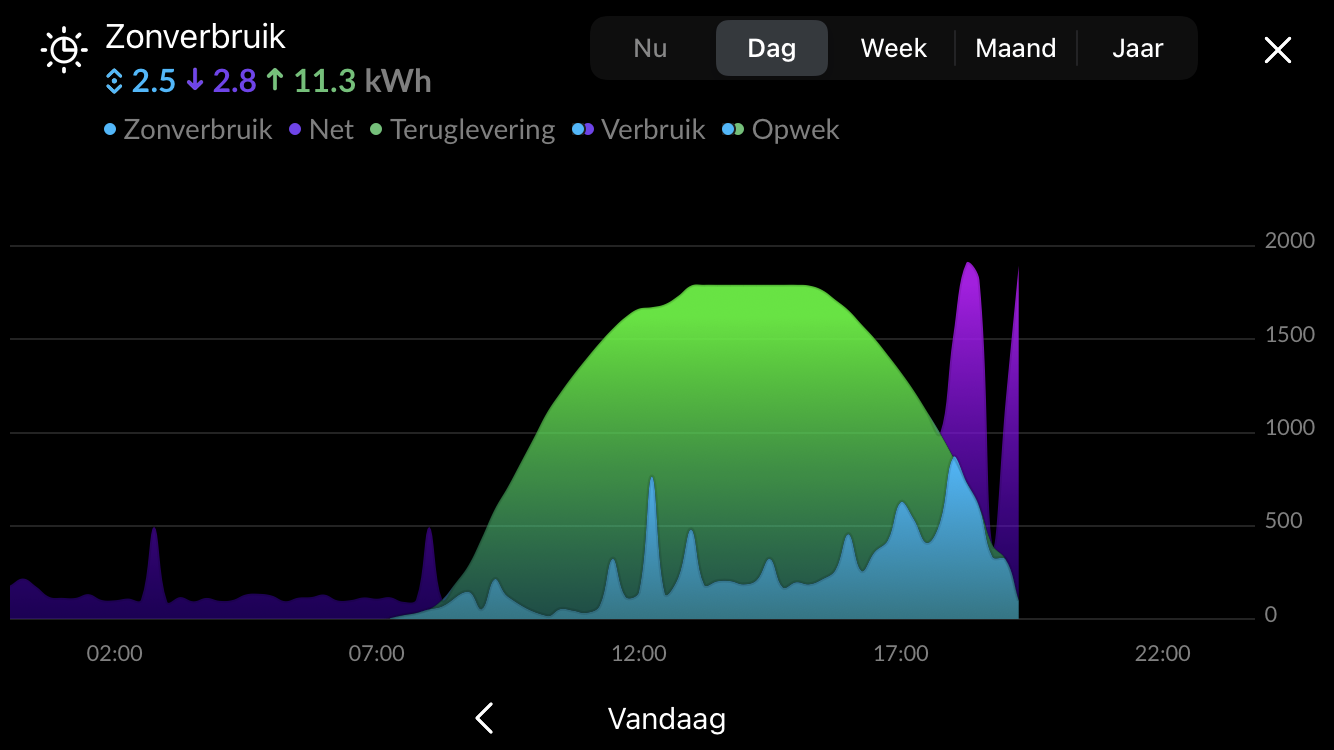
After the solar panels were placed, I could immediately monitor the consumption or production of our electricity on the central grid. To gain more insights a smart colleague advised me to use the P1 meter with a mobile application facilitating in metrics and nice dashboards that really helps a lot to decide in which moment and how many in parallel household electrical appliances can be turned on to make perfect use of our home-made electricity. My next home project is to investigate what can be done to save on standby electricity usage.
Also eat pizza at noon instead of in the evening so the oven is used when there is an excess of solar power (Now big purple bumps pop up at 18:00 to show a large energy consumption outside of the green bubble).
Sustainability at the office
As a DevOps Cloud engineer, I am a proud member of a team with a group of colleagues that enjoys managing and improving one of the Azure cloud platforms called “Rabowings” at scale of Tribe Business Lending.
As an IT Foundations team, we are not just waiting for intensives from the business to embed sustainability into our way of working. We manage our Cloud platform by making use of infra as code. We write code that is easy to understand, good documented and avoids code duplication and deploy scalable infrastructure that is secure, compliant, performant, resilient, cost effective and sustainable. Being sustainable is another facet of our implementation requirements we are embedding in our daily way of working.
Scaling down our servers
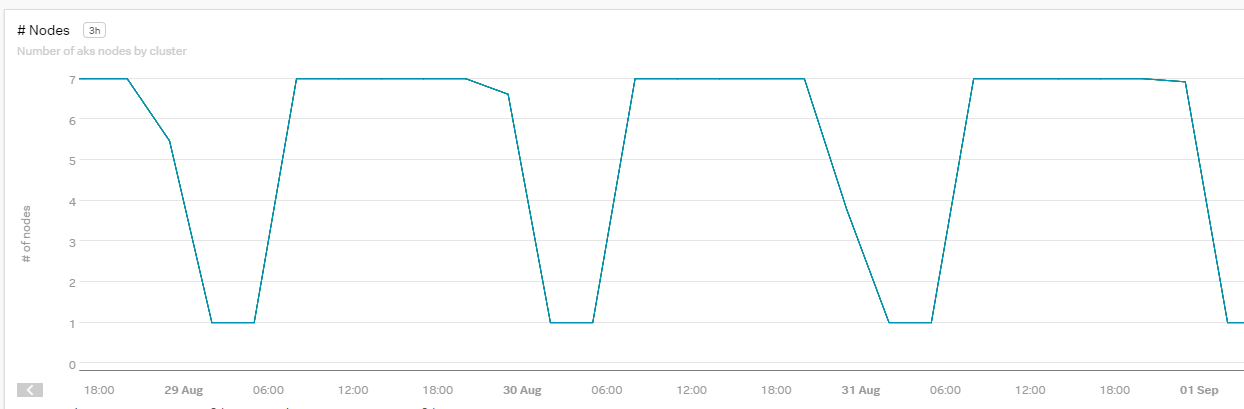
Our applications in the non-production environments were up and running 24/7 hours while scarcely being used during the evenings, nights and weekends. By changing our infrastructure and creating scheduled scripts, we could stop our applications and automatically scale down the number of running servers on our Cloud platform. We also created a script that teams can run by themselves to start their application when needed.
The applications are scaling down every day at 20:00 and scaling up during workdays at 06:00. The number of weekly hours used for the operational work is now 70 hours instead of 168 hours a week!
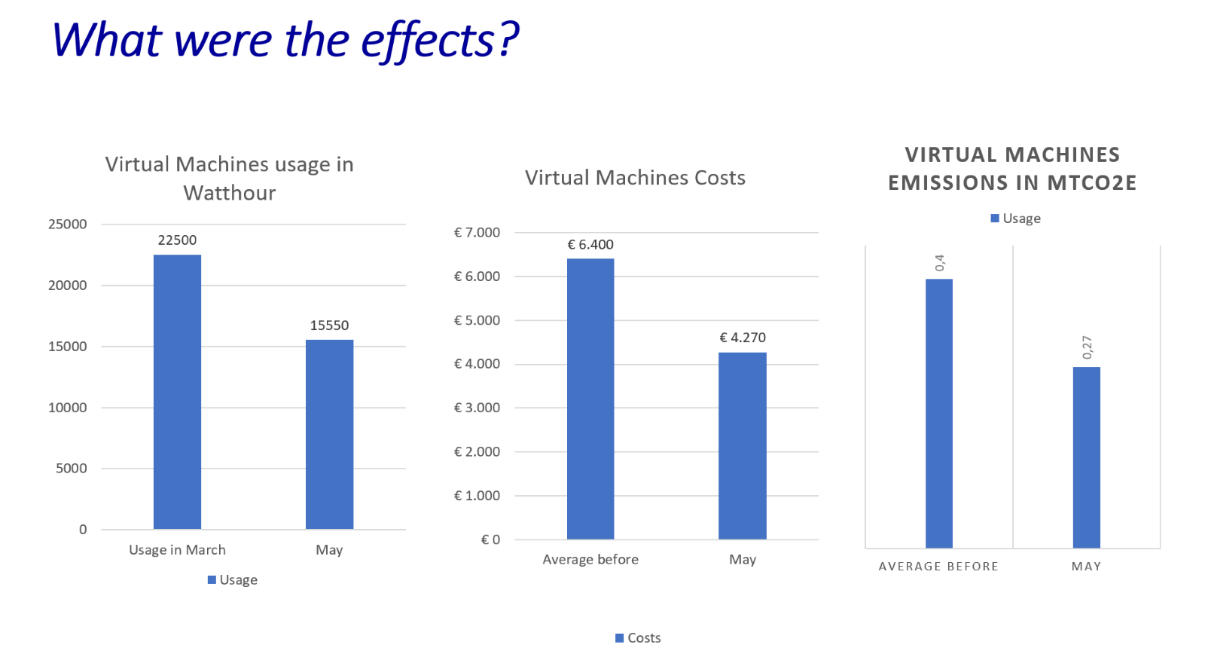
The monthly Watthour of our Virtual Machines reduced from 22.656 in March to 15.668 in May, Virtual Machines emissions in MtCO2e reduced from 0,4 to 0,27 and the costs from € 6.400 to € 4.270.
This measure will help to reduce CO2 emissions and save costs for our Cloud platform.
Further sustainability improvements
At this moment, we are working on implementing a solution of our application provider where the message broker is centralized instead of having an instance for every application. Also, this contributes to saving even more energy and thus reducing costs. Next year, when we migrate to a new type of database server, we want to make use of the new Azure functionality of stopping the database server in the evening, nights and weekends.