Navigating the journey: a comprehensive process to creating data products
In my previous blog post - Embrace the power of data -, I wrote about the importance of the transformative power of data. Highlighting its evolution from a data asset of business operations to a cornerstone of strategic innovation within organisations like Rabobank. Together, we delved into the idea of "data as a product," drawing wisdom from industry pioneers and the principles of Data Mesh. The blog highlighted the architectural and strategic frameworks essential for crafting data products.
Inspired by Marty Cagan’s principles and methodologies in Inspired: How to Create Tech Products Customers Love, this new blog presents a process for organisations to develop data products. The process encompasses discovery, delivery, evaluation, and iteration, aligning architecture with the product lifecycle to ensure success in every phase.

- Anyesh SrivastavaSenior Solution Architect
The Data Product Creation Process
The process consists of three key phases:
- Discovery: Validate the value, usability, feasibility, and viability of ideas through practical evidence and customer-centric exploration. To iterate quickly, identify risks early, and foster collective ownership.
- Delivery: Transform validated ideas into tangible solutions by implementing the data product.
- Evaluation and Iteration: Continuously analyse performance, gather user feedback, and make iterative improvements to ensure the data product delivers consistent value and remains relevant.
This comprehensive approach navigates from ideation to continuous improvement, enabling successful data-driven transformation.
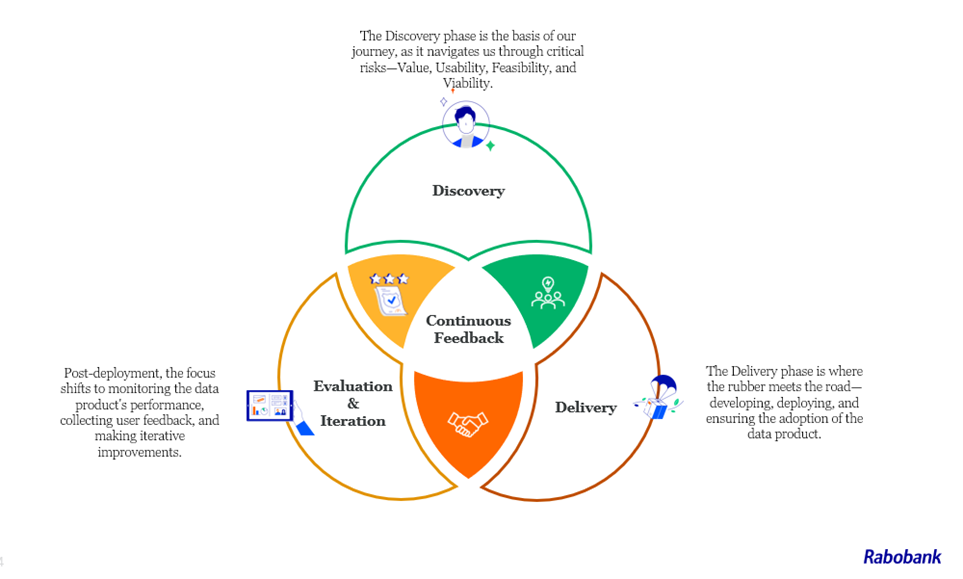
Discovery Phase: A Two-Split Approach
The Discovery phase addresses key risks: Value, Usability, Feasibility, and Viability. This stage ensures alignment with business objectives, verifies that the product meets user needs, confirms technical feasibility, and establishes a strong business case.
The primary goal of the Discovery phase is to identify key risks as early as possible, ensuring that what we are building solves the problem, meets user needs, and aligns with business goals.
To streamline this phase for clarity and effectiveness and to ensure comprehensive coverage of both business and technical aspects, I propose dividing it into two distinctive categories. In my experience, separating business discovery from technical discovery prevents confusion and misaligned goals, ensuring a clear and focused approach for each phase.
- Business Discovery: This phase directs our focus towards identifying and mitigating risks associated with Value, Usability, and Viability. It involves exploring our data product's potential value proposition, ensuring end-user usability, and validating its feasibility within the broader business landscape. This split allows us to concentrate specifically on understanding the business needs and market opportunities, ensuring that the product aligns with strategic goals and provides real value to users.
- Technical Discovery: Our attention shifts to evaluating the technical feasibility of our envisioned data product. We carefully examine the technological complexities, determining what can be feasibly developed while harmonising with our organisation's capabilities and strategic goals. This separation allows for a focused assessment of the technical aspects, ensuring that the proposed solutions are technically sound and feasible within our existing infrastructure.
Phase 1: Business Discovery
Here, I propose focusing more on business and involving key players to make the discovery robust and future-proof. We delve into the essence of the business context and its requirements, emphasising the strategic importance of the data product. This stage is all about understanding the business's challenges, ambitions, and what it hopes to achieve.
Objective:
To determine what data product can fuel business growth and tackle specific functions, highlighting the importance of our contributions to this strategic effort.
Key Activities:
- Engaging with business stakeholders to document business needs (led by Product Manager).
- Identifying privacy risks and ensuring that the data product aligns with relevant data protection regulations (e.g., GDPR, HIPAA), considering any user data or sensitive information that will be processed.
- Conducting focused market research to identify competitive opportunities (led by Business Analyst and Product Manager).
- Setting clear, measurable business goals and determining the data product’s potential impact (a collaborative effort by Product Manager and Business Stakeholders).the potential impact of the data product.
Actors Involved:
- Data Product Team – The Enabler Team
Deliverables:
- Business Requirements Document (BiRD): Outlining business goals, objectives, and use cases.
- Opportunity Assessment: Identifying competitive advantages and market opportunities.
- Product Proposition Canvas: A structured tool capturing customer needs, pain points, and expected gains (value propositions) to ensure alignment with business goals and user problems.
Phase 2: Technical Discovery
Objective:
To evaluate the technical feasibility of the proposed data product. This focuses on determining whether the product can be built, assessing the technical challenges, and ensuring it is feasible within the current technical environment.
Key Activities:
- Assessing the technical challenges and determining if the product can be built.
- Reviewing the current technology stack and infrastructure for compatibility.
- Evaluating technical requirements for ensuring data privacy, implementing authorization controls, and securing access to sensitive information.
- Estimating the resources and effort required for development.
Actors Involved:
- Data Product Team – The Enabler Team
Deliverables:
- Working prototype demonstrating the technical feasibility of the product.
- Feasibility assessment summarising any technical challenges and resource needs.
Delivery Phase: Bringing Ideas to Life
The Delivery phase is where the actual implementation of the intended solution occurs based on the insights and validations obtained during the Discovery phase. This stage ensures the solution is valuable, usable, viable, and feasible.
Objective
To bring the data product from concept to reality, aligning with business requirements and user needs identified during the Discovery phase.
Key Activities
- Testing for reliability and user satisfaction.
- Ensuring that privacy compliance is achieved by validating that appropriate authorisation mechanisms and secure access controls have been implemented.
- Deploying the product and facilitating user adoption.
Actors Involved
- Data Product Team – The Enabler Team
Deliverables
- A working, deployed data product that meets user and business needs.
- Test and quality assurance results are used to ensure the product is reliable and meets defined standards.
- Deployment Strategy to outline a smooth and risk-minimized rollout plan.
Evaluation and Iteration: Ensuring Continuous Value
Post-deployment, the focus shifts to monitoring the data product's performance, collecting user feedback, and making iterative improvements. This stage is vital for keeping the data product relevant and effective.
Objective
To evaluate and refine the data product based on performance data and user input, ensuring it continues to fulfil evolving business and user needs.
Key Activities
- Gathering and analysing user feedback.
- Prioritising and executing enhancements.
Actors Involved
- Data Product Team – The Enabler Team
Deliverables
Data Product Usage Insights: A consolidated report that includes performance metrics, user feedback, identified areas for improvement, and an outline for future enhancements and necessary training.
Conclusion
In summary, creating data products is a complex process that requires a deep understanding of business goals and technical capabilities. By following the structured process outlined, organisations can navigate the complexities involved - from ideation through delivery to continuous enhancement. This ensures that their data initiatives provide significant business value and that they can sustain that value over time.