Why Your AI Initiative Will Succeed or Stall Before the Model Is Ever Trained
Here’s a number worth understanding before you start any AI initiative: 60%. That’s the share of AI projects that Gartner predicts will be abandoned through 2026. Given all the hype around AI, it’s a number that may shock you. And it’s not because the models were wrong. It’s not because the technology failed, either. It’s due to something fundamental that often gets overlooked: The data underpinning them was never ready to begin with (Gartner, 2024).
These aren’t small organizations experimenting with limited budgets. We’re talking enterprises that have hired dedicated AI teams, possess state-of-the-art technology platforms and run multiple pilots. And yet the result is the same: models that don’t scale, projects that don’t reach production and transformation programs that don’t generate the business impact they promised.
Beyond asking why AI is struggling, we need to ask why it continues to get stuck in the same place, for the same reason, across so many different organizations.

- Amr NasrSenior Product Manager
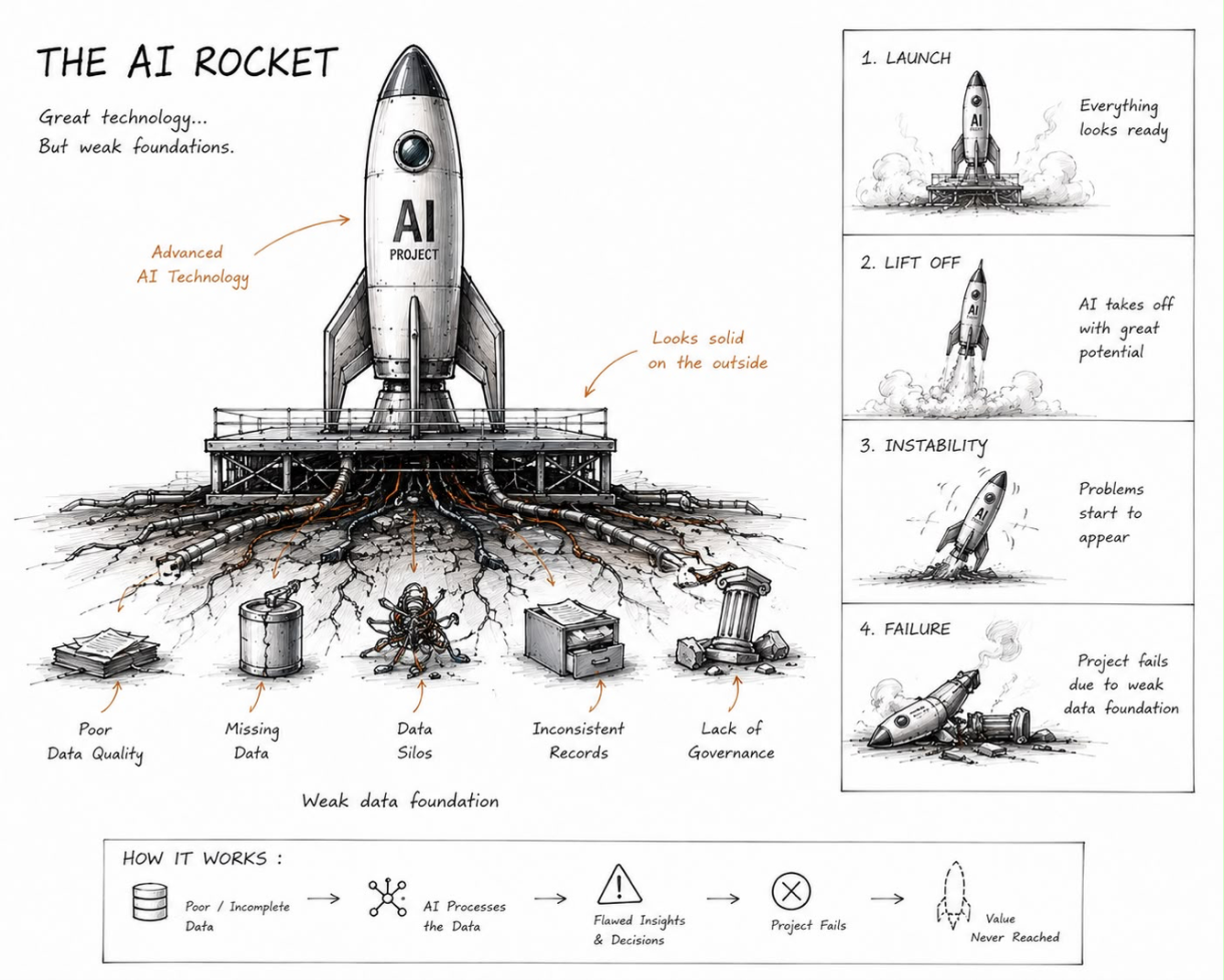
The Proof of Concept Always Works. And That's the Problem
There’s a pattern that plays out in enterprise AI. A team identifies a promising use case. They build a proof of concept on a curated dataset – clean, controlled, carefully scoped. It performs well, impressing stakeholders. The business case looks solid... on paper.
Things begin to fray when the model meets the real world.
Suddenly, the customer records that worked perfectly in the pilot environment are inconsistent across systems. The field that one team calls “customer status” means something completely different in another database. The historical data the model was trained on reflects a product lineup that’s been shelved. Edge cases that never appeared in the controlled pilot appear constantly in production. And the team who was celebrating a successful demo is now spending the majority of their time cleaning data rather than generating insights.
According to BARC’s Data, BI and Analytics Trend Monitor 2026, data quality issues have more than doubled as the primary obstacle to AI success: from 19% of organizations reporting it as a top challenge in 2024 to 44% in 2025. In a single year, data quality went from a background concern to the number-one barrier standing between organizations and the AI outcomes they promised their leaders.
The research sends a clear message: Organizations that invest in foundations, not just models, will be the ones that reap long-term AI success.
Four Data Problems That Quietly Determine AI Outcomes
To understand why so many AI initiatives stall, you have to understand where they actually break. Based on industry research and experience working on enterprise data platforms, we can identify four patterns.
1. Nobody agrees on what the data means
In most large organizations, the same customer exists in multiple systems – sometimes with different names, different identifiers and different attributes. What one system calls an active customer may not have the same definition in another system. When an AI model is trained on data that uses inconsistent definitions, you’ll find it learns the wrong thing and produces outputs that sound confident but lead to expensive mistakes.
Before a single model is trained, organizations need to agree on what their core data concepts actually mean and how they’re enforced at the system level. This requires more than a quick note in a policy document nobody reads.
2. The data exists, but nobody is responsible for quality
Available isn’t the same as reliable. In many organizations, data flows through dozens of systems where nobody is explicitly accountable for end-to-end accuracy. Individual teams manage their own corners of the data landscape, but no one sees the full picture. This setup is disastrous for AI. A mislabeled field becomes a systemic bias. An outdated record becomes a drifted model. A missing value becomes a hallucination.
To remedy this, your data quality needs ownership, not just tooling.
3. Governance slows things down, but skipping it brings everything to a halt
There’s a tension in enterprise AI between the speed that product and AI teams want to move and the careful, deliberate pace that governance and compliance require. The temptation, especially in the early stages of an AI initiative, is to move fast and treat governance as something to retrofit once the model is working. This rarely ends well. Organizations that skip governance in the pilot almost always encounter it later, at the worst possible moment: when the model is in production, the outputs are questionable, and trust is already eroding.
Getting governance right before scaling isn’t just another bit of pesky bureaucracy, it’s serious risk management.
4. The training data reflects the past, not the customer you want to serve
Historical data encodes historical patterns. This includes historical biases, historical product structures and historical customer behaviors that may no longer be relevant. An AI model trained on how your customer behaved three years ago will optimize for a customer segment that has since changed significantly. In financial services especially, where customer needs, products and market conditions never stay the same for long, the freshness and representativeness of training data is just as important as how clean it is.
Your model is only as current as the data it learned from.
Why This Matters More in Financial Services
Every industry faces these challenges. But, as you’re likely aware, financial services face them in a context that amplifies the stakes significantly.
Regulatory requirements mean that AI outputs in banking aren’t merely business decisions. That’s why an AI model that produces unreliable outputs because of poor underlying data doesn’t just create operational problems but also leads to compliance risk, reputational risk and – most importantly – customer harm.
Say you’d like to use a simple AI system that’s designed to help customer service teams identify the right product for a customer’s situation. Even if the data feeding that system is inconsistent, with different definitions of customer status across systems, incomplete interaction histories and mismatched identifiers, the AI will produce responses with complete confidence. But they’re factually incorrect. The agent trusts the output. The customer receives wrong guidance. Trust erodes. The AI initiative that was supposed to improve customer experience has done the opposite.
At the same time, there’s a real opportunity in financial services precisely because of the data these organizations hold. Institutions like Rabobank sit on some of the richest customer data of any industry, particularly when it comes to customer behavior. When that data is well governed, consistently defined and AI-ready, it enables something genuinely powerful: the ability to understand a customer’s financial situation at a depth that allows for personalization, proactive support and frictionless experience at scale (McKinsey Global Institute, 2024).
The question we should be asking isn’t whether financial services organizations should use AI, but whether the data foundation underneath those AI ambitions is ready to support them.
What Getting It Right Actually Looks Like
The organizations reaping the rewards of AI have one thing in common: They treated data governance as a prerequisite, not an afterthought. They resisted the pressure to roll out a model before the foundations were solid, and that patience paid for itself many times over (Dataversity, 2026).
In practice, three measures separate AI initiatives that scale from those that stall.
Start with data readiness, not model selection. Before choosing a model, establish whether the data that will feed it is consistent, governed and representative. Remember: Your model choice matters far less than the quality of what it learns from.
Establish ownership before establishing pipelines. Every critical dataset needs a named owner: someone who’s accountable for its accuracy, currency and fitness for use. Data quality without accountability is a policy document. Data quality with ownership is a real-world application.
Treat data as a product, not as a by-product. The organizations building durable AI capability manage their data the way product teams manage products: with defined consumers, clear quality standards, feedback loops and continuous improvement. Data that’s designed for reuse and alignment with business outcomes is fundamentally different from data that’s a by-product of IT operations (Ness Digital Engineering, 2026).
Our Approach at Rabobank
In my experience working on Rabobank’s data platforms, the conversations about data quality, governance and access happened before AI use cases were defined, not after. Doing things in that order is really important.
Data governance has been a strategic priority because trustworthy, well-governed data is what makes AI scaling possible in the first place. The work of building a solid data foundation isn’t glamorous. It doesn’t generate the kind of excitement that a working AI demo does. But it’s precisely that work that determines whether an AI initiative produces a demo that impresses a room, or a product that genuinely improves the experience of our customers.
Despite its name, your data foundation isn’t just the background to the AI story, but the thing that really gets the plot moving.
Conclusion: The Foundation Determines Everything
The numbers are hard to ignore: 60% of AI projects abandoned, and data quality concerns more than doubling as the primary obstacle to AI success in a single year.
But these numbers tell a hopeful story, too. They mean the organizations that invest seriously in data foundations that define ownership, establish governance and treat data quality as an engineering discipline rather than something done in hindsight have a significant competitive advantage. It’s not because they have better models, but because their models have better data to learn from.
In financial services, that advantage compounds. Well-governed data doesn’t just enable better AI. It enables more trustworthy AI of the kind that can earn the confidence of regulators, the trust of customers and the credibility to scale from a proof of concept into something that changes people’s first-hand experience of their bank.
The model is the easy part. The real work is building the foundation it stands on.
In the Next blog: What every AI PM needs to understand about RAG and why the data foundation we have discussed here is the single biggest determining factor of whether a RAG system works in production.